Signs You Need New Eavestrough (Not Just a Repair)
By True North Eaves · Updated June 19, 2026
Why the repair-or-replace question is easy to get wrong
Eavestrough repairs are satisfying in a low-grade way. Caulk a leaky seam, resecure a loose bracket, and the problem disappears. For a while. The issue is that repairs that keep coming back are often symptoms of something more structural, and every season you spend on patches is a season of water working on the fascia, the soffit, and the wall behind the trough. By the time replacement becomes undeniable, the damage has usually spread past the trough itself.
This is not an argument for replacing things prematurely. Plenty of minor eavestrough problems are genuinely worth repairing. The goal here is to know when the math has shifted.
Signs that point clearly to replacement
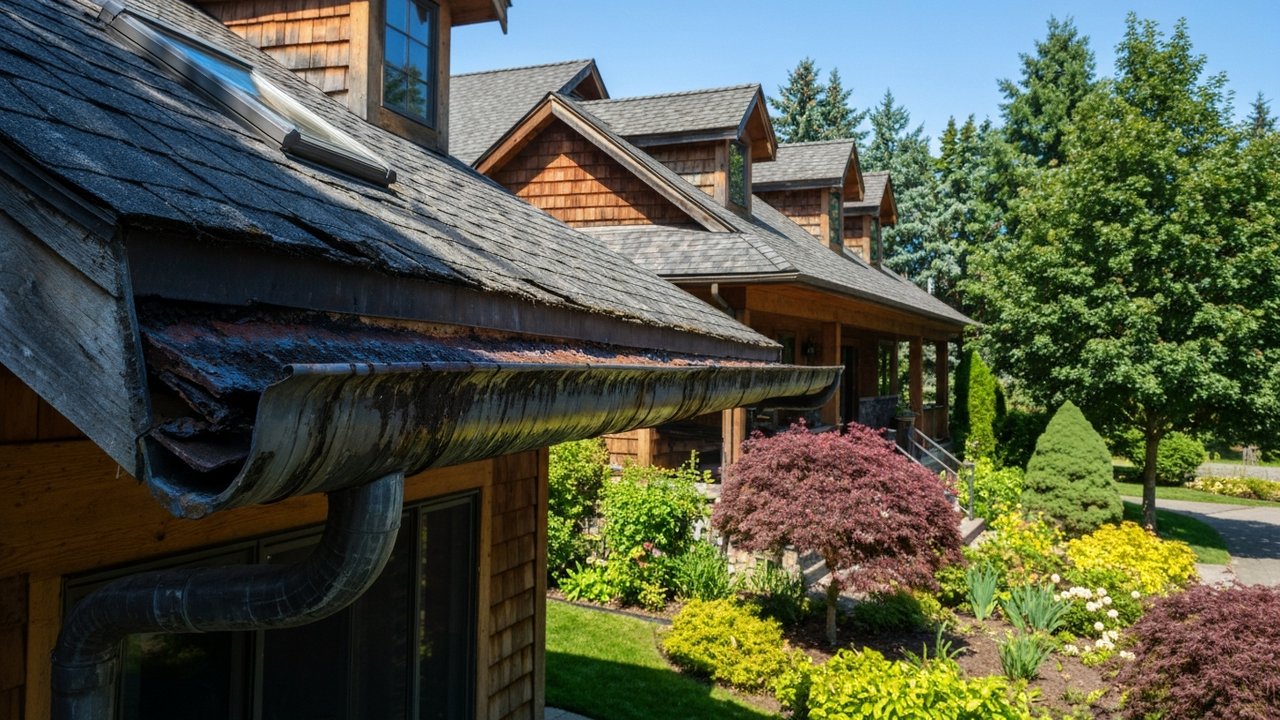
The trough is sagging, and not just in one spot. A single low point usually means a loose or failed hanger that can be refastened. When the sag runs along a long section, or shows up in several different places, the hangers are pulling through the trough body itself. That is a sign the material has deteriorated past the point where refastening holds.
It is pulling away from the fascia board. The trough is supposed to sit flush against the fascia and slope slightly toward the downspout. When the gap opens up, water gets behind the trough instead of into it. Refastening works if the fascia is solid and the holes can grip. If the trough body has corroded around the existing holes, the fasteners have nowhere to grab. That is a replacement conversation, and worth checking the fascia condition at the same time, because water that has been getting behind the trough has had a direct shot at that board for a while.
Rust stains running down from the trough. Aluminium does not rust, so if you see orange streaking, either a steel bracket or fastener has corroded and is running stains down the trough face, or you have a steel trough that is corroding from inside. If the interior of the trough itself has corroded through, no amount of patching changes the underlying material condition.
Visible cracks or holes in the trough body. Small holes can be patched. Long cracks, especially ones that follow the length of the trough or appear across multiple sections, indicate material that has become brittle. Patching brittle material buys one more freeze-thaw cycle.
Seams that fail repeatedly. Sectional eavestroughs have joints every ten feet or so, and those joints are the most common leak points. Resealing a failed joint once is a normal maintenance task. If you are resealing the same seam every spring, and especially if multiple seams on the same run keep opening up, the sections themselves have likely shifted or corroded enough that sealant cannot bridge the gap reliably. The guide on seamless vs. sectional eavestrough explains why seamless systems eliminate most of this as a category.
Functional signs that the trough is not doing its job
Physical condition is one thing. What the water actually does tells you something different.
Overflow when the trough is clear. If you have already confirmed the eavestrough is clean and the downspouts are flowing freely, but you still see water spilling over the front edge during a normal rainfall, the trough is undersized for the roof area it is draining. This is genuinely common in older Canadian homes: standards for sizing have changed, and a trough spec-ed for a different era of roofing material may not handle modern runoff. Cleaning will not fix this. Only replacement, with correct sizing, will.
Staining or peeling paint on the siding below the trough. This usually means water is coming over the edge or dripping from a leak point and running down the wall. Over time it works into the siding itself. If the staining is fresh, the source might just be a blocked downspout. If it is old and widespread, the trough has been misdirecting water for a long time.
Soft or rotted fascia. If you press on the fascia board and it gives, or you can see dark waterlogged wood or paint bubbling away from the surface, the trough has been letting water get behind it. Eavestrough replacement and fascia repair often go hand in hand because the cause of one is usually feeding the other.
Water pooling near the foundation. Eavestroughs exist to carry roof water away from the house, not dump it at the base of the wall. When water is consistently appearing near the foundation on the building side of the downspout, either the downspout is too short, the slope is wrong, or the trough has been overflowing long enough that the ground around the foundation is no longer draining properly. Worth sorting out before it becomes a basement moisture problem.
What age tells you
Painted aluminium is the most common eavestrough material on Canadian homes and, in a typical climate, it has a useful life somewhere in the range of two to three decades. Vinyl holds up less well under the freeze-thaw cycling that is part of life across most of Canada, and tends to become brittle and prone to cracking sooner. Steel is less common but susceptible to corrosion once the protective coating breaks down.
If you do not know how old your eavestroughs are, the profile and the hangers often tell you. Older systems were frequently installed with spike-and-ferrule hangers: a long spike driven through the front of the trough into the fascia. Those tend to loosen over years as the wood swells and contracts. If your eavestroughs are original to a house that is 30 or more years old, replacement is worth a real conversation regardless of their current apparent condition.
When a repair is actually the right call
None of this means every eavestrough problem requires replacement. A single section that took a hit from a branch or a ladder, a joint that has opened up in an otherwise-sound run, a hanger that pulled loose on a relatively new installation: these are good candidates for repair. The deciding factor is usually scope. One problem in one location, on an eavestrough that is otherwise performing well, is a repair. Multiple problems across the system, or a functional failure that no repair addresses, is a replacement.
Frequently asked questions
How do I know if my eavestrough is just old or actually failing? Age alone is not the whole story. An older eavestrough that is still draining cleanly, sitting tight against the fascia, and showing no signs of corrosion or cracking may have years of service left. The combination of age with two or three of the physical or functional signs above is when replacement becomes the better call.
Can I patch a crack in an aluminium eavestrough? Yes, with the right sealant or flashing patch, and it often holds well for a season or two. The question is what the crack tells you. A single crack from a one-time impact is worth patching. A crack that follows a stress line in material that is becoming brittle suggests the same trough will develop another one close by before long.
What happens to my fascia if I wait too long to replace a failing eavestrough? Water getting behind or over the trough works on the fascia first, then the soffit and the wall below. Fascia is replaceable, but the longer the moisture exposure, the more material is involved. Catching a deteriorating eavestrough before the fascia is seriously affected saves the follow-on repair.
Is replacement a good time to add gutter protection? It often makes sense to consider it. When the eavestrough is being replaced and everything is set up, it is a natural point to evaluate whether protection fits your situation. Are gutter guards worth it walks through who benefits most. A free assessment covers both the replacement and whether protection makes sense at the same time.
Want this looked at on your own home?
Book a free, no-obligation in-home assessment.
Book my free assessment →