How to Choose an Eavestrough Company in Canada
By True North Eaves · Updated June 22, 2026
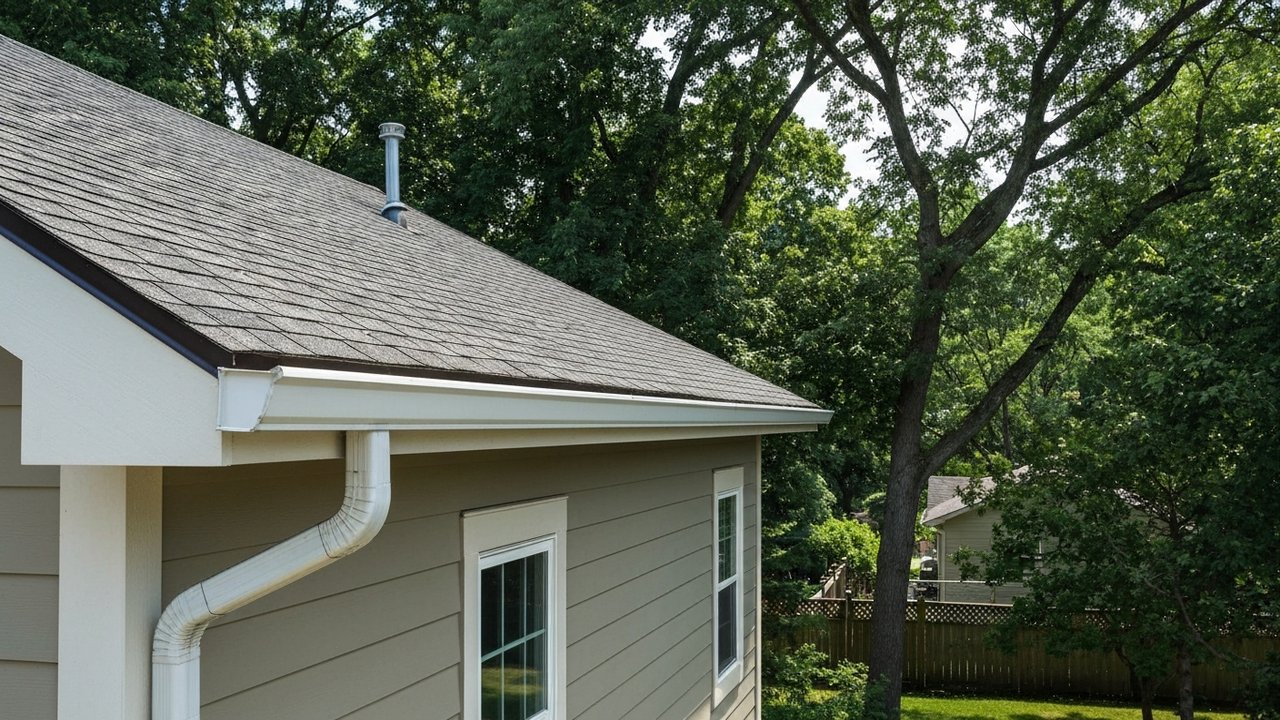
What an eavestrough company is actually doing
Eavestroughs, commonly called gutters, have one job: catch the water running off your roof and route it safely away from the house through downspouts. When they are blocked, misaligned, or leaking at the seams, that water ends up soaking the fascia board behind the trough, dripping down the siding, and pooling at the foundation. In a Canadian climate, that pooling water freezes, expands, and does compounding damage year after year.
So when you hire an eavestrough company, you are not just paying someone to run a strip of aluminum along the roofline. You are managing where your roof water goes for the life of that installation, which has real consequences for the wood structure and foundation behind the scenes. A company that cuts corners on slope, hanger spacing, or downspout positioning is creating a problem you will not notice until the damage is already done.
Most reputable companies offer some combination of eavestrough replacement, gutter protection, and soffit or fascia repairs. It is worth knowing what the company actually specialises in before you hire, because a firm that mostly sells gutter guards may not notice that your fascia is already rotting, and a firm focused on replacement may steer you toward new troughs when a good guard would solve your problem for less disruption.
The credentials that matter in Canada
Two things you should always confirm before any work starts:
Liability insurance. Eavestrough work involves ladders, rooflines, and frequent upper-storey access. If a worker is injured on your property or causes damage to your home, you want the contractor’s policy to cover it, not your homeowner’s insurance. Ask for a certificate of insurance and confirm it is current.
WSIB or provincial workers’ compensation coverage. In Ontario, a WSIB clearance certificate confirms that the crew is covered under workers’ compensation. Other provinces have equivalent bodies: WCB in Alberta and BC, CNESST in Quebec, and similar programs elsewhere. Ask for the clearance certificate directly. If a contractor is evasive about this, that is your answer.
There is no national trade licence for eavestrough installation in Canada the way there is for electricians or plumbers, so insurance and workers’ compensation coverage are the practical gatekeepers. A legitimate company will hand over both documents without hesitation.
What a written warranty actually covers
Warranties on eavestrough work come in two parts, and they are not the same thing.
Product warranty covers the materials, typically the aluminum, the seams, and any coatings or finish. Most reputable manufacturers stand behind their product for a meaningful number of years against defects in the material itself.
Workmanship warranty covers how the contractor installed it: the slope, the sealing of joints, the spacing and security of hangers, the positioning of downspouts. This is the one that matters when your trough starts pulling away from the fascia two winters after install. A workmanship warranty that lasts only one year offers very little protection in a climate with Canadian winters, and plenty of low-bid contractors offer no workmanship warranty at all. Get the terms in writing and read what they actually cover before you sign.
For gutter protection, the same split applies. Some manufacturer warranties are voided if the guard is not installed by a certified contractor, which means hiring a handyman at a lower rate may leave you with no warranty coverage at all. Confirm that both the product warranty and the workmanship warranty are documented and that the installation method does not void either.
Red flags worth knowing
A few patterns that should give you pause:
Quoting without seeing your home. Eavestrough systems vary considerably in size, roofline complexity, and access. A contractor who gives a firm number based on your address and approximate square footage is guessing. A real quote requires a real look, especially in older neighbourhoods where rooflines are irregular and existing troughs may be in mixed condition.
Verbal commitments that do not appear in writing. Whatever the salesperson says about materials, warranty terms, or what the job includes should appear on the written contract. If the conversation promises “full coverage on anything that goes wrong” but the paperwork says one year on labour only, the paperwork governs.
Pressure to sign on the day. A genuinely good company does not need you to commit before you have had time to compare other quotes or think it over. High-pressure close tactics are a signal, not a negotiating move.
Quoted prices that are dramatically lower than everyone else. Sometimes a low quote means a more efficient crew. More often it means thinner-gauge aluminum, shorter hangers, fewer downspouts than the system needs, or a workmanship warranty that disappears when you try to use it.
Difficulty reaching the company after the quote. How a company treats you during the quoting process is a reasonable preview of how they will treat you when something needs to be fixed.
How to compare quotes properly
Two to three quotes is practical for most eavestrough jobs. More than that and the differences become difficult to evaluate, especially when specs vary slightly between contractors.
When comparing, make sure you are comparing the same material. Ask each contractor whether the aluminum is seamless (formed on site to your home’s exact lengths) or sectional with pre-formed joints. Seamless aluminum has fewer potential leak points than sectional, which is a meaningful advantage in a Canadian climate where freeze-thaw cycling stresses every joint. The tradeoffs between the two are worth understanding, and seamless vs. sectional eavestrough covers them in detail.
Also ask what happens at the downspouts. A well-positioned downspout routes water far enough from the foundation to actually protect it. Extensions, splash pads, and underground drainage connections are all options depending on your grade. A contractor who does not mention downspout positioning at all during the quote is not thinking about the system as a whole.
Where gutter protection fits in
If your existing eavestroughs are structurally sound but you are tired of cleaning them, or you have trees that mean the job will repeat indefinitely, gutter protection is worth considering before you commit to a full replacement.
On the guard side, the range runs from budget foam inserts and coarse screens at the lower end through mid-range foam and brush systems, up to professional stainless micromesh at the premium end. The difference is not only where they sit relative to each other on price. It is what they actually keep out. Fine micromesh keeps pine needles and grit out in a way that coarser options genuinely cannot, which matters a great deal if you have conifers nearby. Are gutter guards worth it goes deeper on when protection earns its place and when it does not.
As an independent LeafFilter consultant, we book free in-home assessments and refer homeowners to LeafFilter for professional micromesh installation. LeafFilter sits in the middle of the market, not the most expensive option and not the least, and what it works out to for your home depends on the size and complexity of your eavestrough system. When LeafFilter is installed, the existing troughs are cleaned, realigned, and sealed as part of the process. We do not offer standalone eavestrough cleaning. If your troughs are in poor shape to begin with, we will tell you that, because protection installed over failing eavestroughs is not money well spent. Book a free assessment and we will look at the whole picture honestly.
When replacement comes first
Gutter protection makes sense when the underlying eavestroughs are solid. If they are sagging, separating at the seams, pulling away from the fascia, or so rusted or damaged that patching them is not practical, the right move is replacement first. Installing guards over failing eavestroughs just caps a problem. Our eavestrough replacement service is available if that is where you land, and the assessment will tell you clearly whether replacement is the necessary starting point.
Frequently asked questions
Does an eavestrough contractor need to be licenced in Canada? There is no national trade licence for eavestrough work, unlike the licensing requirements for electricians or plumbers. The credentials that matter in practice are liability insurance and provincial workers’ compensation coverage (WSIB in Ontario, WCB in Alberta and BC, and equivalents elsewhere). Ask for both certificates in writing before any work starts. A contractor who cannot produce them is taking on risk at your expense.
Should I get my eavestroughs cleaned before calling for a quote? Not necessarily. A reputable contractor will assess the current condition as part of the quote. If you are looking at LeafFilter installation specifically, cleaning is included as part of the installation process, not a separate step you need to arrange beforehand.
How do I know if a workmanship warranty is actually worth anything? Read it before you sign. A real warranty names what is covered, for how long, and what would void it. Vague language like “we stand behind our work” with no time period or claims process is not a warranty you can rely on. Look for a specific term in years, a clear list of what is covered, and a defined way to make a claim. If the contractor is unwilling to put specific terms in writing, that tells you something.
Is a larger national company a safer choice than a local contractor? Not automatically. Some smaller regional contractors do careful, durable work and back it properly. What matters is current liability insurance, valid workers’ compensation coverage, a written workmanship warranty with real terms, and what previous customers in your area say about their experience. A company with strong local references and solid written terms is a better bet than a larger brand with weak follow-through once the job is done.
Want this looked at on your own home?
Book a free, no-obligation in-home assessment.
Book my free assessment →