Wildfire Insurance in Canada: Do FireSmart Homes Get a Discount?
By True North Eaves · Updated June 19, 2026
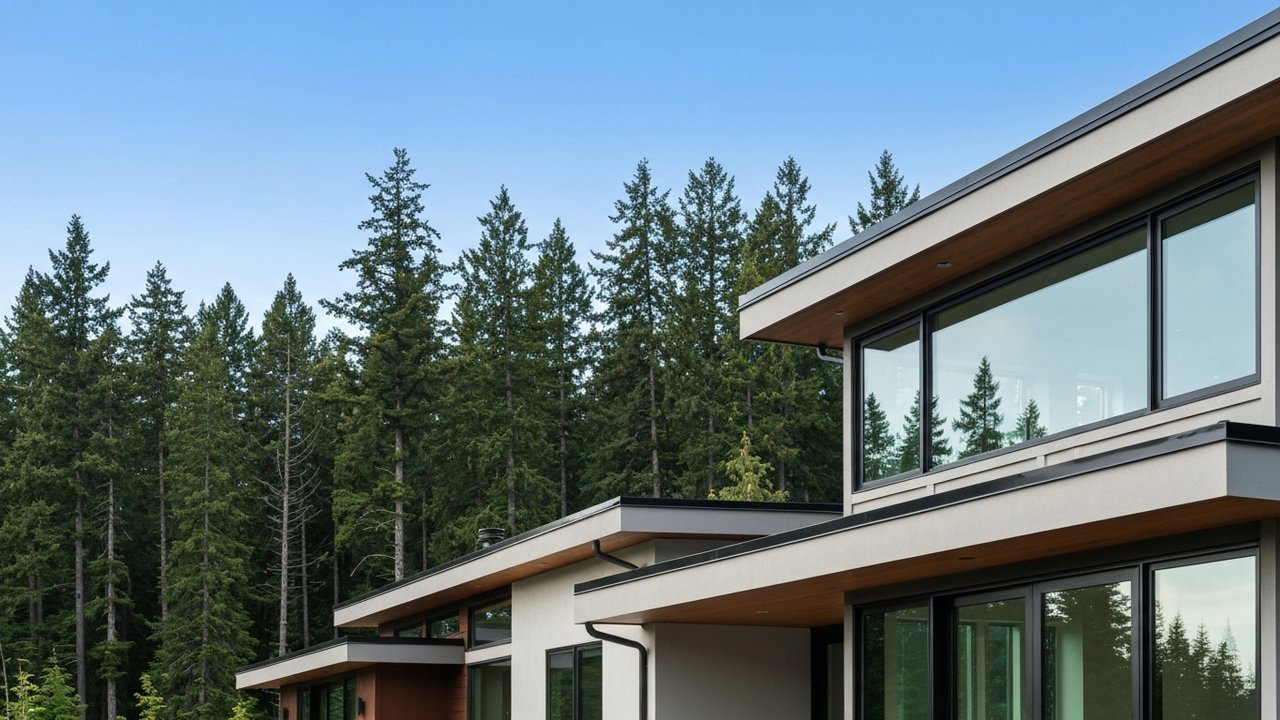
How wildfire is reshaping Canadian home insurance
Wildfire has gone from a regional worry to a national pressure on the home insurance market. The Insurance Bureau of Canada has reported a sharp rise in insurable losses over the past decade, with extreme weather, wildfire included, driving claims to record highs. Statistics Canada has confirmed the same trend: severe weather is reshaping how home insurance is priced and offered across the country.
For homeowners, that shows up in a few ways. Premiums have climbed, especially in and around fire-prone communities. Underwriting has tightened, with several insurers now asking specific questions about properties in wildfire interface zones. In the highest-exposure areas, some homeowners are seeing stricter conditions, exclusions, or difficulty getting coverage at all. The cost of reinsurance, the insurance that insurers themselves buy, has risen after back-to-back catastrophic seasons, and that pressure flows down to your renewal.
The honest takeaway is that if you live near forest or grassland, wildfire risk is now part of how your home is underwritten, whether or not you have ever filed a claim.
Do FireSmart homes actually get a discount?
This is the question everyone asks, so here is the straight answer: not as a standard, industry-wide thing.
A small number of insurers recognize FireSmart work directly. In British Columbia, FireSmart BC lists insurance partners, including BCAA and Co-operators, that offer a saving to homeowners who complete a FireSmart assessment and achieve certification. Co-operators has promoted recognition for FireSmart-certified homes nationally as well. But these are voluntary partnerships, not a rule that every carrier follows. FireSmart BC openly invites other insurers to join, which tells you it is still the exception rather than the norm.
So if you are doing FireSmart work mainly to chase a guaranteed rebate, temper that expectation. Where a recognized discount exists it tends to be modest, and many homeowners will not find one with their current carrier at all. The stronger reason to do the work is the one underneath the discount question.
Why mitigation matters even without a rebate
In a tightening market, the thing worth protecting is your ability to get and keep coverage on fair terms. Mitigation is increasingly part of that conversation. When an underwriter is weighing a home in a higher-risk area, a property that has clearly reduced its wildfire exposure is an easier risk to write than one that has not. Insurers also point out that wildfire is a shared problem, so individual work matters most when the surrounding neighbourhood is doing it too.
In practice that means the value of FireSmart-style work is qualitative. It can help keep you insurable, support your case at renewal, and reduce the odds your home is the one that ignites. None of that comes with a promised dollar figure, and any specific saving depends entirely on your insurer, your area, and your policy.
The Home Ignition Zone and where embers land
FireSmart Canada organizes home protection around the Home Ignition Zone, the area immediately around and on your house. Its guidance is built on a hard fact: an estimated 90 percent of homes damaged or destroyed by wildfire are ignited by embers, not by a wall of flame. Embers ride the wind well ahead of a fire and look for somewhere to settle and smoulder.
Two of the places they settle are the roof and the eavestrough. FireSmart recommends a Class A fire-rated roof assembly, which includes materials such as metal, asphalt shingle, clay or concrete tile, because the roof is the most vulnerable surface on the house. It also recommends keeping the roof and eavestroughs clear of needles, leaves and other combustible debris, and screening eavestroughs (also called gutters) with metal mesh, with gutters and downspouts made of non-combustible material such as aluminum, galvanized steel or copper. See FireSmart Canada at firesmartcanada.ca for the full Home Ignition Zone guidance. We are not a FireSmart program and we do not certify homes; we simply follow its published advice on the roof-edge details.
Connecting your eavestroughs to the ember problem
A trough packed with dry pine needles and leaf litter is exactly the kind of tinder an ember is looking for, sitting right at the edge of your roof and against your fascia. Clearing that debris and keeping it from coming back is one of the simpler, more direct things you can do in the Home Ignition Zone.
This is where a fitted metal micro-mesh gutter protection system fits the FireSmart picture. A non-combustible metal mesh keeps needles and leaves out of the trough so there is nothing in there to catch an ember, while still letting water through. A capable do-it-yourself metal micro-mesh screen is a legitimate route if you are handy and your roof is safe to work on. A professionally fitted system such as LeafFilter is the other route, with the existing eavestroughs cleaned, realigned and sealed as part of the install so the system starts clear. To be clear, we do not offer standalone eavestrough cleaning; clearing the troughs is simply part of installing the protection properly. If your troughs are failing, replacement may need to come first.
On price, LeafFilter is not the most expensive option and not the least; it sits somewhere in the middle, and the only real number comes from a free in-home assessment of your actual roofline. For how that works and where it lands in the market, see how much LeafFilter costs in Canada.
How True North Eaves helps
True North Eaves is an independent LeafFilter consultant, not an authorized dealer and not a FireSmart program. We book a free in-home assessment, look at your roof, your trees and your existing eavestroughs, and tell you honestly whether metal gutter protection makes sense for your home and your risk. If it does, we book it through LeafFilter and the troughs are cleaned, realigned and sealed as part of the install. For any insurance discount tied to FireSmart, talk to your own insurer or broker, since that depends entirely on your carrier and your area. Book a free assessment or check the service areas we cover.
FAQ
Will FireSmart work lower my home insurance premium? Sometimes, but it is not guaranteed or standard. A few insurers, mostly in British Columbia, recognize FireSmart assessment and certification with a saving. Most carriers do not post a discount for it, so check with your own insurer or broker rather than assuming one exists.
If there is no discount, why bother with mitigation? Because in a tightening market the bigger payoff is staying insurable on fair terms. Reducing your wildfire exposure makes your home an easier risk to underwrite, which matters more than ever in high-risk areas, and it lowers the odds your home ignites in the first place.
How do clean eavestroughs reduce wildfire risk? Roughly 90 percent of homes lost to wildfire are ignited by wind-blown embers, and dry debris in roof valleys and troughs is a common landing spot. Keeping the roof and eavestroughs clear removes that fuel right at the roof edge. Non-combustible metal micro-mesh screening keeps the debris out so there is nothing to catch.
Do I have to use LeafFilter to be safer? No. A good do-it-yourself metal micro-mesh screen is a legitimate option if your roof is safe to access. A professionally fitted system is the other route, with the troughs cleaned and sealed as part of the install. We do not sell eavestrough cleaning on its own.
Want this looked at on your own home?
Book a free, no-obligation in-home assessment.
Book my free assessment →