What Drives the Cost of New Eavestrough
By True North Eaves · Updated June 21, 2026
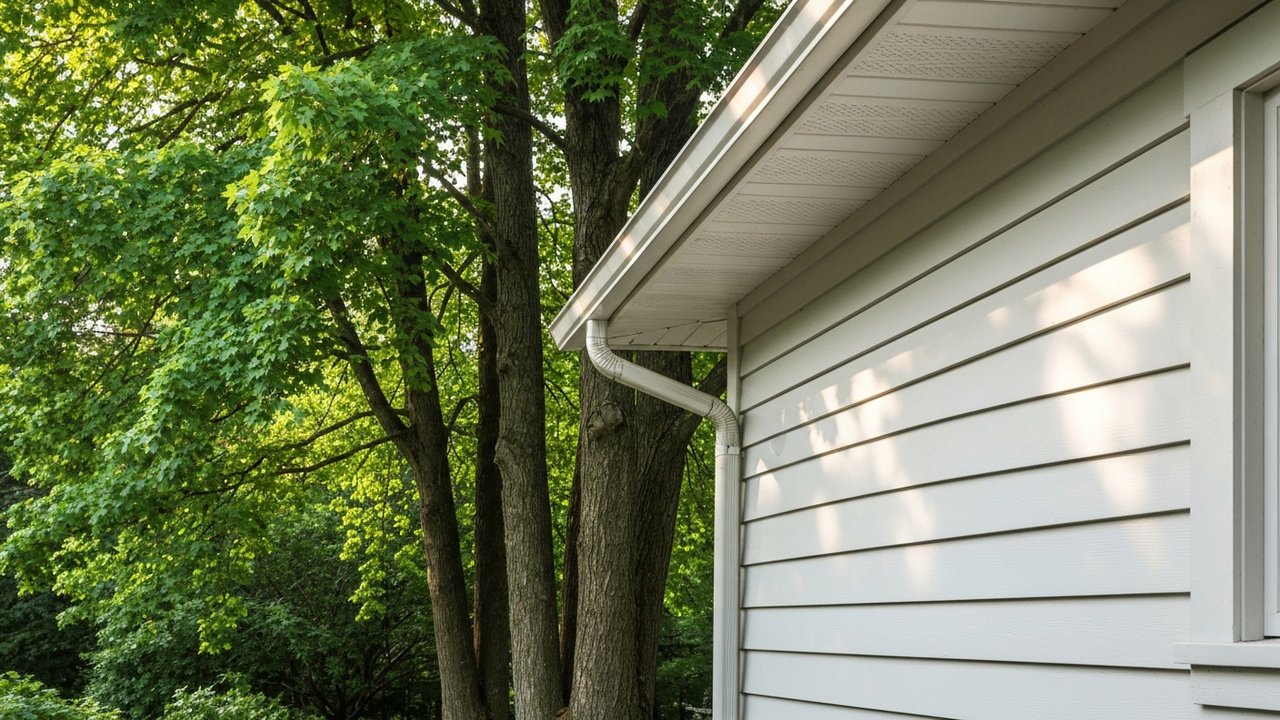
How much eavestrough your roofline needs
The most straightforward input is how many linear metres of eavestrough your home requires. Every run of trough, every downspout drop, every inside corner, outside corner and end cap adds to the scope. A simple rectangular roofline needs less than a home with an irregular footprint, an attached garage run, a breezeway or multiple downspout locations.
This is also why you cannot calculate it yourself from a rough tape measure. A professional takes accurate measurements of every run, accounts for each fitting, and plans the downspout locations to handle your actual drainage. That is the foundation any real quote is built on.
Roofline complexity
Total length only tells part of the story. A long, straight run is faster to work with than the same length broken into multiple levels, dormers, tight inside corners and awkward geometry. Every inside corner needs a mitre or a corner piece fitted to match the profile exactly. Dormers create junction points that take time and care to seal correctly. A steeply pitched roof or one with limited ground clearance around the perimeter adds time and equipment.
Complexity matters because labour is a meaningful part of the total, and a complex roofline takes longer to work on regardless of the material chosen.
Material
Eavestrough (sometimes called a gutter) comes in a few materials, each with different durability and price positioning.
Aluminium is the most common choice in residential Canada. It does not rust, holds paint well, handles the freeze-thaw cycles that are a fact of Canadian winters, and comes in a wide range of colours. The majority of new installations use aluminium.
Steel is heavier and stronger, which suits areas with serious snow and ice loads. It sits higher on the cost scale than aluminium and needs proper coating to resist corrosion, but it can be the right answer for a home that takes a real beating every winter.
Copper is at the premium end. It is extremely durable, develops a natural patina over time and is mostly used for heritage properties or homes where visual detail matters as much as performance. It is substantially more expensive than aluminium or steel.
Vinyl is at the lower-cost end, but it can become brittle in the severe cold common across Alberta, Saskatchewan, Manitoba and northern Ontario. For most of Canada, aluminium is the practical choice over vinyl.
Profile
Profile refers to the cross-sectional shape of the trough. Five-inch K-style is standard for most homes. Six-inch K-style handles higher roof loads and is worth considering for a large roof area that dumps a lot of water quickly (think a wide garage or a sprawling ranch-style home). Half-round is a heritage profile that suits older homes architecturally but costs more to source and fit.
Choosing the right profile is partly about water volume and partly about what looks right on the house. A professional can walk you through the trade-offs for your specific roofline.
Seamless vs. sectional
Sectional eavestrough comes in pre-cut lengths joined with connectors. It is the type sold at hardware stores and can be a DIY project, which keeps the initial outlay lower. The trade-off is the joints: every connector is a potential leak point, and those points multiply as the system ages.
Seamless eavestrough is cut on-site from a continuous coil to match the exact length of each run, so there are no mid-run joints. The only connections are at corners and downspouts. It costs more to install because it requires a truck-mounted roll-forming machine and professional installation, but it performs better over time because there are far fewer places to fail. Most professional installations use seamless. For a full comparison of what each approach means in practice, see seamless vs. sectional eavestrough.
What shape your existing system is in
If you are replacing eavestroughs because the current ones are failing, the condition of what is behind the trough matters. The fascia board is the wooden board the eavestrough hangs from, and it rots when a trough leaks or overflows long enough without being caught. Installing new eavestroughs onto compromised fascia means the new system will not hold properly, so the fascia needs to be addressed in the same scope of work. Eavestrough replacement often involves a fascia inspection as a first step precisely for this reason.
Removal and disposal of old eavestrough is also part of the job. It takes time and has to be accounted for in any honest quote.
Access and site conditions
A home with open ground around the perimeter is straightforward to work around from any angle. A tall home, one with mature landscaping tight against the walls, a steep lot grade or a roofline that is hard to ladder-access safely takes longer. In some cases extra equipment is needed. Access is not the biggest factor, but it is something a professional notices the moment they walk the perimeter and it goes into the scope.
Getting a real number
None of these factors can be properly weighed without looking at your home. A rough estimate from a web form is a guess. A real quote accounts for your actual linear metres, your specific roofline, the material you choose, and the access and site conditions that only show up on the ground.
True North Eaves books free in-home assessments across our service areas. No ballparks, no pressure. Book a free assessment and we come to you.
Frequently asked questions
What is the single biggest cost driver for new eavestrough? The total linear metres of eavestrough your roofline requires. It sets the baseline that everything else builds on. Roofline complexity, material, profile and access all matter, but length is the starting point.
Does the material I choose really make a difference in Canada? It does. Aluminium handles Canadian freeze-thaw cycles well and is the practical standard for most homes. Vinyl can become brittle in severe cold, which limits its usefulness across much of the country. Steel and copper are durable options that sit higher on the cost scale and suit specific situations rather than being the everyday choice.
Do I need to replace the whole system or can I replace sections? Sometimes selective replacement makes sense if only one section is failing and the rest is sound. A professional can judge whether the condition of the whole system makes a complete replacement the smarter long-term call. That is part of what a free in-home assessment tells you.
How long does new eavestrough last in Canadian conditions? Properly installed aluminium eavestrough can last several decades. Steel and copper tend to outlast aluminium. The weak points in any system are the joints (more of a concern with sectional than seamless), the hangers, and any underlying fascia issues that go unaddressed over time.
Want this looked at on your own home?
Book a free, no-obligation in-home assessment.
Book my free assessment →