FireSmart Grants and Rebates in Canada, by Province
By True North Eaves · Updated June 19, 2026
How FireSmart funding actually flows in Canada
FireSmart is national guidance, but the money is layered. On June 12, 2025, the federal government, several provinces and territories, and the Canadian Interagency Forest Fire Centre announced a combined investment of 104 million dollars through the Government of Canada’s Resilient Communities through FireSmart (RCF) program (Natural Resources Canada). That money mostly funds provinces, communities and capacity building, not direct homeowner cheques.
So the honest way to think about it: FireSmart Canada (firesmartcanada.ca) sets the standard, the provinces administer the funding streams, and your local government decides if and how a homeowner gets reimbursed. That is why two neighbours in different regional districts can have completely different options.
What kind of work tends to qualify
Across the programs that do reach homeowners, the qualifying work clusters around the Home Ignition Zone, the area FireSmart breaks into the Immediate Zone (the first 1.5 metres around the house), Intermediate Zone, and Extended Zone. FireSmart Canada notes an estimated 90 percent of homes damaged or destroyed by wildfire are ignited by embers, not by a wall of flame, so the priority is removing the small spots where a blowing ember can land and catch.
Commonly funded or recommended items include:
- Non-combustible roofing and clearing the roof of needles and leaves.
- Screening or upgrading vents and soffits so embers cannot get inside.
- Clearing the eavestroughs (often called gutters) of debris and screening them with metal mesh.
- Replacing combustible siding, decks, fencing and windows.
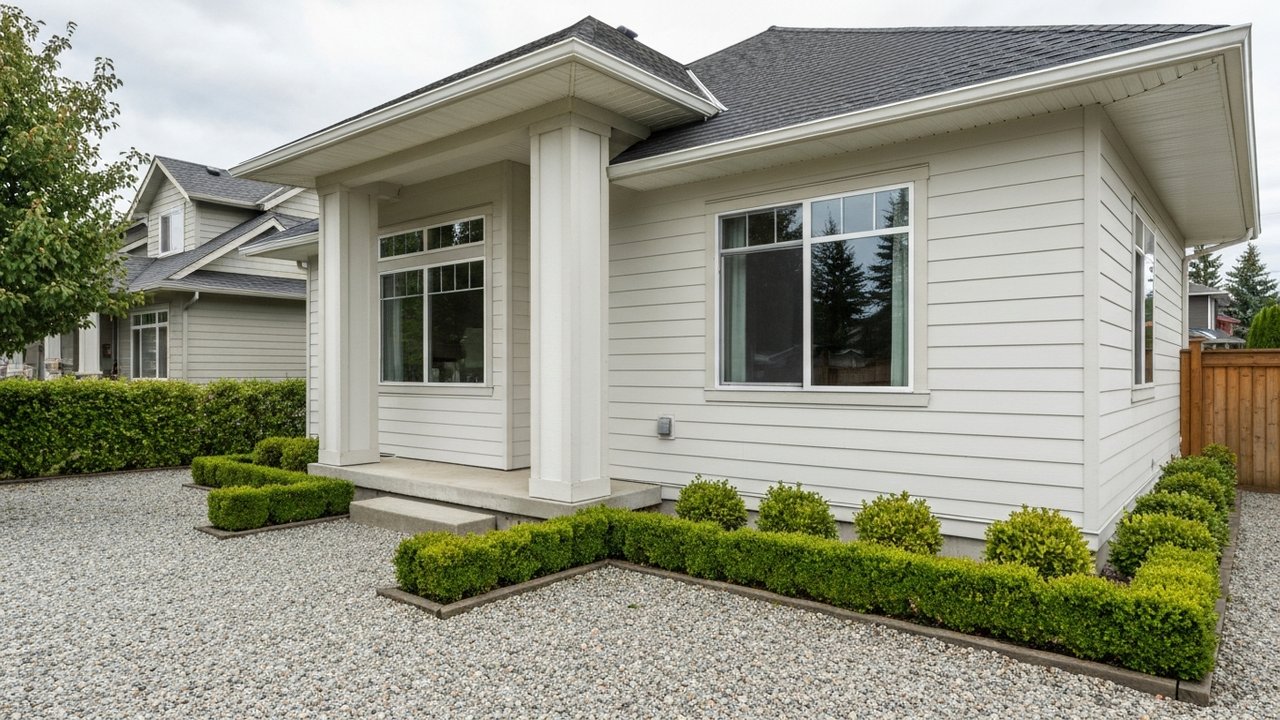
- Creating that non-combustible 1.5 metre Immediate Zone (gravel or stone instead of bark mulch and shrubs against the wall).
FireSmart’s own guidance is blunt about the roofline: regularly clean combustible debris like needles and leaves from the roof and gutters, and “screen your gutters with metal mesh to reduce the amount of debris that can accumulate” (FireSmart Alberta, firesmartalberta.ca). That is the same logic behind quality gutter protection, which we cover below.
British Columbia
British Columbia has the deepest bench of homeowner rebates, but they are run locally rather than province-wide. The funding source is usually the Community Resiliency Investment (CRI) program and its FireSmart Community Funding and Supports stream, administered through the Union of BC Municipalities (gov.bc.ca). Individual regional districts and cities then design their own rebate.
Examples as of 2025 and 2026 (confirm current details with each one before you spend):
- Thompson-Nicola Regional District launched a homeowner rebate of up to 50 percent to a maximum of 500 dollars for mitigation work within 1.5 metres of the home, and brought a version back for 2026 (tnrd.ca).
- Squamish-Lillooet Regional District reimburses 50 percent of materials, hired labour or time spent on mitigation (slrd.bc.ca).
- The Cowichan Valley region has offered qualified homeowners up to 4,000 dollars through CRI funding (emcowichan.ca).
These programs open and close with funding, sometimes first-come first-served. Start at firesmartbc.ca and then your own regional district or city.
Alberta
Alberta’s homeowner-facing programs tend to be municipal. The standout is the Regional Municipality of Wood Buffalo (Fort McMurray area), whose FireSmart Home Rebate Program reimburses wildfire-resistant upgrades, with the municipality citing amounts such as up to 2,000 dollars for roof work and up to 4,000 dollars for siding, supported in part by a 200,000 dollar grant from Intact Insurance (rmwb.ca). The key condition is the order of operations: you must complete a free FireSmart Home Assessment before work begins to qualify, and that program has been set to run until funds are exhausted, with 2026 activity reported and an end target around mid-2026. Confirm whether it is still open before you count on it.
Outside designated programs, much of Alberta’s FireSmart effort is community-level education and assessments rather than individual cheques. Provincial guidance lives at firesmartalberta.ca, and your municipality or county fire service is the place to ask about a local rebate.
Other provinces and territories
Coverage thins out east and north. Through the RCF program, Newfoundland and Labrador, Nova Scotia, Prince Edward Island, Manitoba, Yukon and others have received federal and provincial funding, but much of it targets community projects, mapping and capacity, not direct homeowner rebates (Natural Resources Canada). Ontario and Quebec, as of 2026, have limited dedicated homeowner FireSmart rebates compared with BC, though local programs can appear. If you are outside BC or a funded Alberta municipality, the realistic path is a free FireSmart assessment where offered plus doing the mitigation on your own dime, since the protection is worthwhile either way.
How to find and apply
- Search “[your municipality or regional district] FireSmart rebate” and check firesmartcanada.ca, firesmartbc.ca or firesmartalberta.ca.
- Book the free FireSmart Home Assessment first. Most rebates require it before work starts, and it tells you exactly what to prioritize.
- Keep receipts and before-and-after photos. Reimbursement programs almost always need proof of work.
- Confirm the cap, the percentage, the deadline and what counts, because these change year to year.
Where the roofline fits in
A lot of FireSmart work is the roofline: the roof, the eaves, the soffit, and the eavestroughs that collect exactly the dry needles and leaves an ember loves. Clogged eavestroughs are a fuel source sitting right at your roof edge. Keeping them clear and screening them with metal micromesh is squarely in line with FireSmart guidance.
True North Eaves is an independent LeafFilter consultant. We are not FireSmart and do not certify or endorse on FireSmart’s behalf, and we book a free in-home assessment for LeafFilter gutter protection. When LeafFilter goes on, the existing eavestroughs are cleaned, realigned and sealed as part of the install, and the micromesh keeps debris from building back up at the roof edge. We do not sell standalone eavestrough cleaning. A do-it-yourself metal micro-mesh screen is a legitimate option too, and you can compare approaches in are gutter guards worth it. On price, LeafFilter is not the most expensive and not the least, somewhere in the middle, with the real number coming from the free assessment. Book a free assessment to look at your roofline.
FAQ
Is there a single national FireSmart grant I can apply for? No. The big federal number, the 104 million dollar Resilient Communities through FireSmart investment announced in June 2025, funds provinces and communities, not individual homeowners directly. Your eligibility for a cash rebate depends on whether your municipality or regional district runs one. Start local and confirm the current details, since programs open and close with their funding.
Which province has the best homeowner rebates as of 2026? British Columbia has the widest spread, with many regional districts and cities offering rebates (often 50 percent up to a cap) through the Community Resiliency Investment program. Alberta has strong municipal programs in places like the Regional Municipality of Wood Buffalo. Elsewhere, funding tends to be community-level rather than per homeowner. Always check your own municipality before assuming.
Does clearing or screening my eavestroughs count as FireSmart work? Yes, it is core FireSmart guidance. FireSmart advises cleaning roofs and gutters of debris and screening gutters with metal mesh, because needles and leaves at the roof edge are easy ember fuel. Whether a specific rebate reimburses it depends on that program’s rules, so confirm with the program before you spend.
Will gutter protection make my home safe from wildfire? No single product does that, and we would never claim a home is immune or guaranteed. Ember protection at the roofline is one layer in the larger Home Ignition Zone approach, alongside roofing, vents, the 1.5 metre non-combustible zone, and the rest of FireSmart’s guidance. Keeping eavestroughs clear and screened removes one common ignition point, which is meaningful but not the whole job.
Want this looked at on your own home?
Book a free, no-obligation in-home assessment.
Book my free assessment →