The Home Ignition Zone: The First 1.5 Metres That Decide If a Home Survives
By True North Eaves · Updated June 27, 2026
Why embers do most of the damage
Most Canadians picture a wildfire moving in as a wall of flame that physically contacts the house. That does happen, but it accounts for a smaller share of residential losses than most people assume. The larger driver is firebrands: burning fragments that the fire’s convective column lofts into the air and carries well ahead of the active front.
In the 2016 Fort McMurray fire, in the 2023 Kelowna and West Kelowna fires, and in the 2024 Jasper fire, neighbourhood-scale losses happened in part because embers had already landed on structures long before flame reached the street. The firebrand can be a burning cedar shake, a leaf fragment, a piece of bark. It does not need direct flame to touch your wall. It just needs to find somewhere to rest and enough fuel around it to sustain ignition.
That understanding is what drove researchers to focus on the immediate zone around the house rather than the forest edge hundreds of metres away.
What the 1.5-metre zone includes
FireSmart Canada divides a property into three concentric zones around the home. The innermost, Zone 1, runs from the exterior wall out to roughly 1.5 metres. It is the shortest zone and carries the most weight, because anything that ignites here has immediate access to the structure.
The zone includes more than most homeowners expect at first glance:
- The ground surface right against the foundation (mulch, bark chips, combustible planters, ground covers)
- The underside of decks and stairs, where debris tends to collect in sheltered pockets
- Combustible storage against the house: firewood, cardboard, recycling bins, seasonal gear
- The lower wall cladding itself
- Your eavestroughs and whatever is collecting inside them
- The fascia board the eavestroughs attach to
- Soffits and their vent openings, which connect to the attic cavity
The reason this zone matters so much is simple: there is no buffer. A fire that ignites something in Zone 1 is already against the house.
Eavestroughs as an ember landing strip
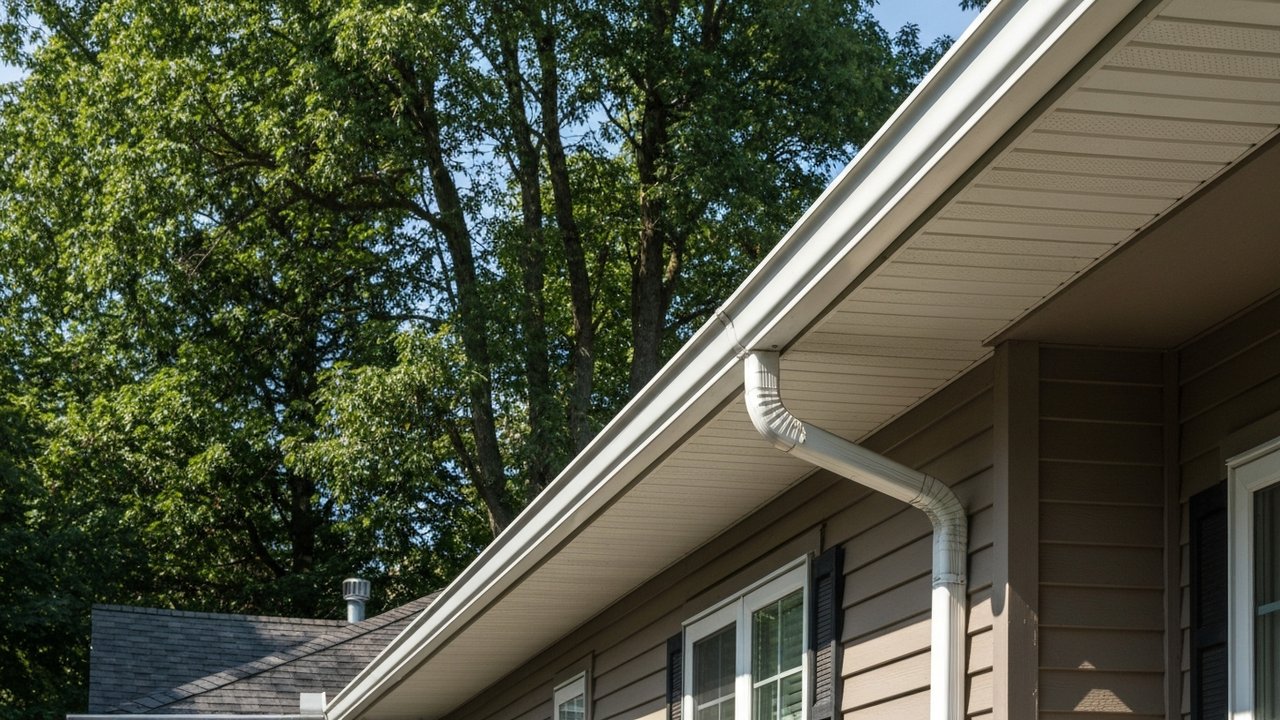
An eavestrough (also called a gutter, though eavestrough is the more common term in Canadian construction) sits at the precise junction where the roof meets the wall, which is exactly the point where an ember needs to land if it wants to bridge the gap from the outside to the structure above.
An open trough does not just catch rainwater. Everything that falls off the roof above accumulates in it: conifer needles, shredded leaves, seed pods, and the fine organic grit that washes down from older shingles. By midsummer in much of Alberta, British Columbia, and the boreal fringe of Ontario, a neglected eavestrough can hold a dense mat of material that has baked dry through weeks without significant rain.
That material ignites readily. A single burning ember settling into a dry debris-packed eavestrough can hold its heat long enough to start the pile. From there, the fire has access to the fascia board behind the trough, the roof edge, and potentially the attic space above. Because ignition starts at an elevated point on the house, it also has a natural updraft to climb.
A fine-mesh eavestrough cover keeps that combustible layer from forming in the first place. The mesh passes rainwater through and excludes the leaves, needles, and grit that would otherwise accumulate. It does not eliminate every conceivable ember risk, but it removes the ready fuel at the roofline that makes ember ignition so easy and so fast.
Soffits and the attic pathway
Connected to the eavestrough problem is what lives just above it: the soffit, which covers the underside of the roof overhang. Most Canadian homes built before the mid-2010s have perforated vinyl or aluminum soffits with relatively large vent openings, because those openings are how the attic breathes in summer and keeps moisture from building up in winter.
Those same vents are also how embers can reach the inside of the house. An ember small enough to pass through a standard soffit vent opening enters the attic and lands in a space full of fibre insulation and wood framing. An attic ignition from ember intrusion is extremely difficult to detect and stop from the outside, and it can burn through the roof well before it is noticed.
The practical mitigation involves both defending the eavestrough (so embers are not drifting along the roofline collecting in the first place) and confirming that your soffit vents have fine mesh over them. If your home is in or near a fire-risk area, a soffit inspection is worth putting on the list alongside your broader home hardening work.
The rest of the immediate zone
The roofline is the highest-priority part of Zone 1, but the ground level matters too.
The ground surface. Bare soil, gravel, concrete, and decomposed granite do not ignite. Organic mulch and bark chips directly against the house do. Replacing combustible ground cover in the immediate zone with rock or gravel is one of the simplest and most durable upgrades available.
Decks and stairs. Composite and metal decking ignite less readily than dry wood. The enclosed space beneath an older wood deck collects debris and shelters embers from rain long after a fire has passed. If you have a wood deck, check what is accumulating under it.
Firewood. A cord of wood stacked against the garage wall is a serious exposure when fire risk is elevated. Relocating it outside the immediate zone, or under a non-combustible cover away from the house, costs nothing.
Lower wall cladding. Vinyl and wood siding both ignite from sustained ember contact. Stucco, fibre cement, and masonry are more resistant. This is typically a longer-term renovation consideration, but it helps homeowners understand which upgrades have actual wildfire value and which do not.
Where gutter protection fits in
Eavestrough protection is not a complete wildfire strategy on its own. However, it addresses a specific and measurable vulnerability in Zone 1. A professional micromesh system, installed correctly, keeps the debris layer from forming inside the trough. The eavestrough stays clear, and there is no dry fuel at the roofline for a drifting ember to settle into.
Whether that makes sense for your home depends on your tree coverage, your roof complexity, and the wildfire risk in your area. A home in an established urban neighbourhood faces a different risk profile from a property in the foothills west of Calgary, along the Highwood, or in the communities rimming the BC Interior where wildland-urban interface fire is an ongoing planning concern.
For more on how eavestrough protection relates to wildfire risk across Canada’s regions, the wildfire gutter protection guide covers the regional picture in depth. If you want to know whether a LeafFilter gutter protection system makes sense for your roofline, book a free assessment and we will look at your eavestroughs, the debris load they carry, and the overall condition of your roofline. The installation includes cleaning, realigning and sealing the existing eavestroughs before the mesh goes on, so the system starts clear rather than capping over a debris layer.
FAQ
What is the Home Ignition Zone? It is the area within approximately 1.5 metres of your home’s exterior walls, identified in wildfire research as the critical zone where most residential ignitions begin. Home losses in wildfires are caused primarily by embers landing in this zone and finding dry material to ignite, not by direct flame contact. FireSmart Canada builds its home hardening framework around this finding, starting with Zone 1 as the highest priority.
Do eavestrough guards actually help with wildfire risk? A fine-mesh eavestrough cover helps by removing the debris that would otherwise accumulate in the trough and serve as ready fuel for a landing ember. An empty, covered trough is considerably less likely to ignite from ember contact than one holding dry leaves and pine needles. It is one useful piece within a broader Zone 1 hardening approach, and it happens to solve the clogging and overflow problems that matter on non-fire days too.
What other steps matter in the 1.5-metre zone? Replacing combustible mulch around the foundation with gravel or rock, removing firewood or combustible storage from the zone, ensuring soffit vents have fine mesh protection, and checking what is collecting under any wood deck are all practical and relatively low-cost steps. The FireSmart Canada program provides a structured walkthrough of all three zones if you want to move through the property systematically.
Does the Home Ignition Zone concept apply everywhere in Canada? Yes, though the actual risk varies by location. The concept was developed from research on home losses in western North America, where wildland-urban interface fires are frequent. It applies to homes in the BC Interior, the Alberta foothills, Ontario’s boreal fringe, and Maritime communities where interface fire has become a planning consideration. Even in lower-risk areas, the principle holds: embers are the main mechanism of ignition, and the zone immediately around the house is where that ignition is most likely to start.
Want this looked at on your own home?
Book a free, no-obligation in-home assessment.
Book my free assessment →